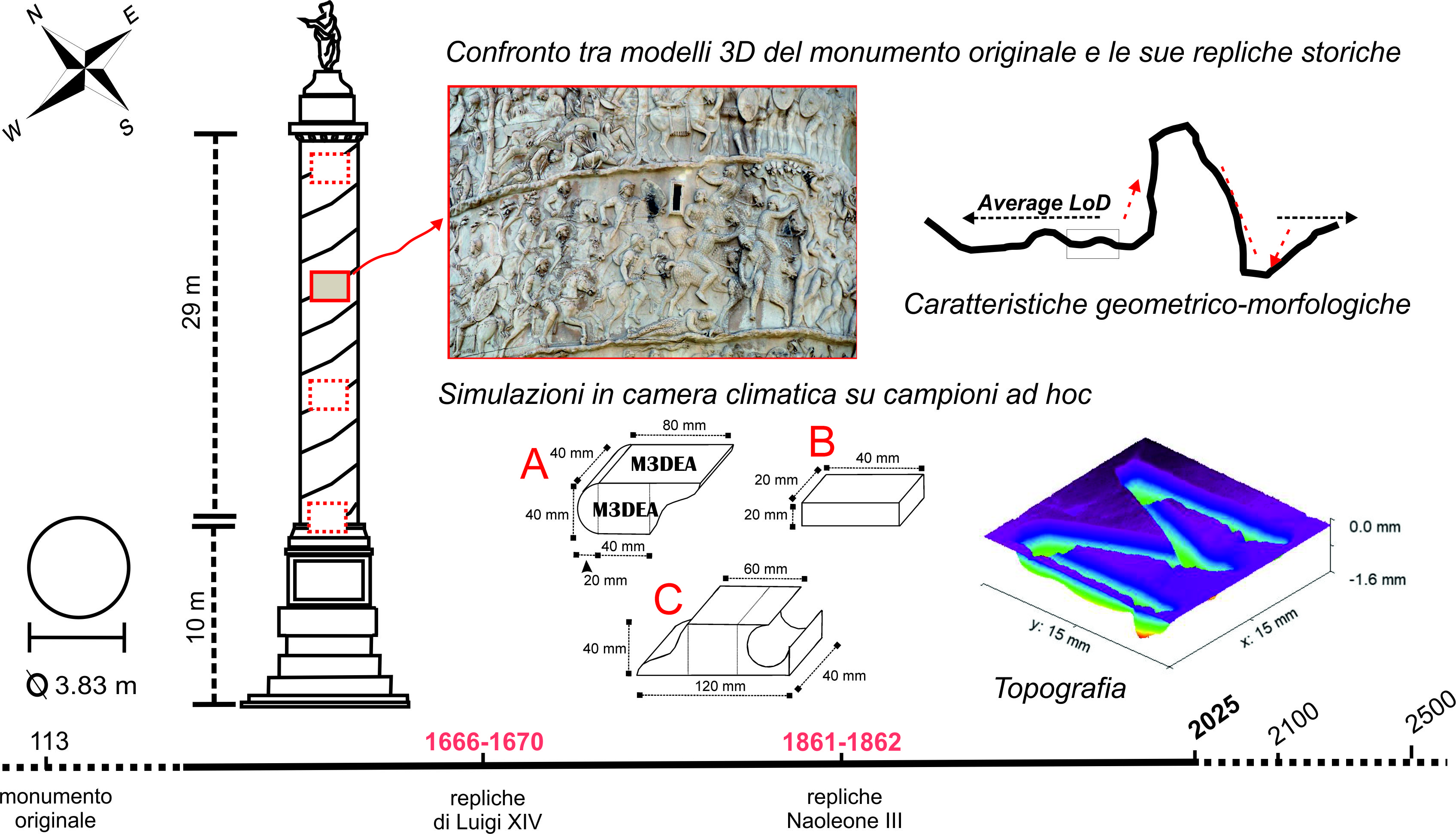
M3DEA approach will develop the following methodological steps:
STAGE A: The laboratory simulation (outgoing phase, secondment in UGR): the raindrop effects and other climate parameters/conditions (temperature, humidity, presence of salts) will be evaluated according to Köppen’s classification as surface stone recession (in terms of loss of surface material). Ageing analyses will be conducted on samples prepared by reproducing decorative elements using an environmental cabinet, modifying environmental parameters (temperature, RH, presence of salts (e.g. NaCl), type of rainfall), in order to simulate different climate conditions. During the test cycles, stone surface changes will be quantified by means of: i) 3D modeling; ii) topographic measurements with a portable 3D optical profilometer (Jr25-NANOVEA); iii) modified interaction whit water droplets measuring the contact angle according to EN828:2013. Beyond Carrara marble (that is the marble used for the Trajan’s Column), other carbonate rocks commonly used in the Mediterranean area will be studied: Nanto stone (Italy), Istria Stone (Croatia) and Sivec marble (Macedonia). This will allow to consider different features in terms of porosity, surface roughness, grain-size and, thus, to cover a larger range of damage rate function (DRF) estimation to be applied in a broader cultural heritage asset (see STAGE C).
STAGE B: DIM, decay assessment and 3D data management (outgoing phase, UCalgary): the 3D modelling by Structure from Motion (SfM) photogrammetry, hyperspectral analysis, and infrared thermography (thermal stress will be monitored in two seasonal surveys) of the entire Trajan’s Column will be performed on-site. Results will be managed in relation with the monument exposure to the main stressors (e.g. rainfall, sun irradiation) by using climate data from Regione Lazio. A detailed DIM high-resolution downscaling is planned on selected areas of the monument with the same parts reproduced in the XVII and XIX centuries, conserved at the museums involved and with the photographic reports (1980-90s).High-resolution models obtained from the original monument, replicas and photographs will be quantitatively compared by 3D meshing point clouds according to: i) different exposition related to cardinal and specific geometric indexes.
STAGE C: LoD quantification and FCV projections (return phase, UNIPD): Combining results obtained during the STAGE B with those achieved during the laboratory simulation (STAGE A) it will be possible: i) to refine the DRF for Carrara marble; ii) to consider the effects of micro-climate conditions and to assess the evolution of the decay process of the monument regarding to the LoD (from the end of XVII century up to the present), and iii) and to make FCV projections of the monument. A final upscaling approach will allow to make projections on a large scale for different climate conditions and different types of carbonate rocks in order to apply the DIM approach in other historical urban contexts (e.g., to years 2050, 2200, etc.) according to IPCC scenarios and in order to draw guidelines for local authorities.